AI Development Process Explained for Non-Technical Founders
A simple guide to the AI development process for non-technical founders, covering idea validation, data preparation, MVP development, testing, launch, and improvement.
Abdul Ahad Akram, CEO & Founder, XenonDev
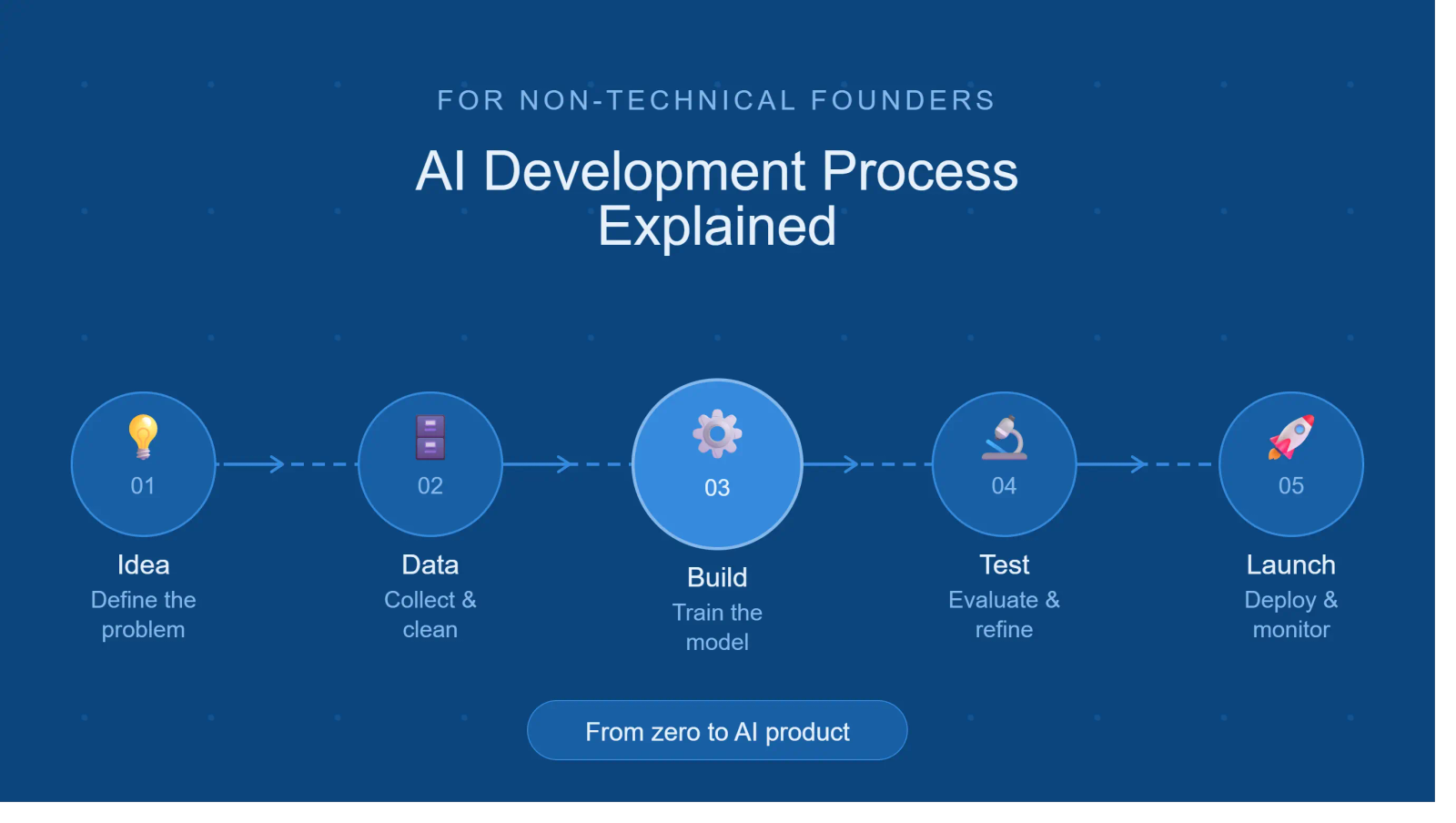
The AI development process can feel confusing if you are a non-technical founder. You may have a strong idea for an AI product, chatbot, automation system, or SaaS platform, but you may not know what actually happens between the idea and a working product.
The good news is that you do not need to understand complex machine learning concepts to build with AI. You only need to understand the main stages, the decisions that matter, and how to avoid common mistakes.
This guide explains the AI development process in simple terms so you can work confidently with an AI development team and build a focused product that solves a real business problem.
What Is the AI Development Process?
The AI development process is the step-by-step approach used to turn an AI idea into a working product or automation system.
For most founders, the process includes:
- Defining the business problem
- Validating the idea
- Preparing the data
- Choosing the right AI approach
- Building the MVP
- Testing the AI system
- Launching and improving the product
The goal is not just to “add AI.” The goal is to use AI to create a faster, smarter, or more efficient solution for a real user problem.
Step 1: Define the Problem First
Every successful AI product starts with a clear problem.
Many founders begin with a broad idea like, “I want to build an AI chatbot.” But that is not specific enough. A better version would be, “I want to build an AI chatbot that answers common customer support questions and reduces support tickets.”
Before development starts, define:
- Who will use the AI product?
- What problem are they facing?
- How are they solving it now?
- What should AI improve?
- How will success be measured?
This step keeps the product focused and prevents your team from building features that look impressive but do not create business value.
Step 2: Validate the AI Idea
Before investing in full AI product development, validate the idea.
Validation helps you confirm that users actually need the solution and are willing to use or pay for it. This is especially important for non-technical founders because it reduces the risk of spending money on the wrong product.
You can validate an AI idea with customer interviews, landing pages, waitlists, manual prototypes, no-code demos, or pilot projects.
For example, before building a complete AI document processing platform, you could manually process documents for a few potential customers using existing tools. This helps you understand their workflow before investing in custom development.
Step 3: Prepare the Data
Data plays a major role in the AI development process. Your AI system may need information from documents, websites, databases, CRMs, spreadsheets, customer support tickets, or internal knowledge bases.
Good data leads to better AI output. Poor data leads to unreliable results.
Before building, check whether your data is accurate, updated, organized, and safe to use. You should also know whether the AI needs live access to your data or only a fixed knowledge base.
For example, if you are building an AI customer support assistant, it needs accurate FAQs, product documentation, policies, and support content. If that content is outdated, the AI may give wrong answers.
Step 4: Choose the Right AI Approach
Not every AI product needs a custom AI model. In fact, most AI MVPs can be built using existing AI models, APIs, and automation tools.
For most non-technical founders, there are three common options.
Existing AI Models
Existing AI models are usually the fastest and most cost-effective option. They can help with chatbots, summarization, content generation, document analysis, classification, and data extraction.
RAG Systems
RAG, or Retrieval-Augmented Generation, allows AI to answer questions using your own business data. This is useful for customer support bots, internal knowledge assistants, and document search tools.
Custom AI Models
Custom AI models are usually needed only when existing models cannot solve the problem or when you have a large proprietary dataset. They are more expensive and take longer to build.
For most AI product development projects, the best approach is to start with existing models or RAG, then improve after real user feedback.
Step 5: Build a Focused AI MVP
An AI MVP is the simplest working version of your AI product. Its purpose is to test whether your solution solves the main problem for real users.
A strong AI MVP should include:
- One clear use case
- Core AI functionality
- A simple user workflow
- Basic data connection
- Error handling
- Usage tracking
- Feedback collection
Avoid building too many features in the first version. Advanced dashboards, multiple integrations, custom models, and complex automation can usually wait.
A focused MVP helps you launch faster, control costs, and learn from real users.
Step 6: Test the AI System
Testing is critical because AI can sometimes produce inaccurate, inconsistent, or unsupported answers.
Your AI product should be tested for accuracy, relevance, speed, security, data privacy, user experience, and edge cases. You should also test for hallucinations, which happen when AI gives a confident but incorrect answer.
To reduce this risk, your team can use better prompts, approved data sources, RAG, source references, human review, and guardrails.
Testing helps make the AI system reliable enough for real users.
Step 7: Launch, Monitor, and Improve
After testing, launch the AI product with a small group of users first. This could be internal users, beta testers, pilot customers, or early paying customers.
After launch, monitor how users interact with the product. Track where the AI performs well, where it fails, which outputs users edit, how much the system costs to run, and whether it solves the original problem.
AI development does not end at launch. The best AI products improve continuously through better data, improved prompts, user feedback, new integrations, and product refinements.
Common Mistakes Non-Technical Founders Should Avoid
The most common mistake is starting with technology instead of the problem. AI should solve a real business issue, not just make the product sound advanced.
Another mistake is making the MVP too large. A big MVP increases cost, slows launch, and makes validation harder.
Many founders also assume they need a custom AI model. In most cases, existing models or RAG are enough for the first version.
Other mistakes include ignoring data quality, not testing enough, forgetting ongoing AI costs, and launching without clear success metrics.
How Long Does AI Development Take?
The timeline depends on product scope, data quality, integrations, and complexity.
A simple AI automation may take 2 to 6 weeks. A focused AI MVP may take 6 to 12 weeks. A more advanced AI product may take 3 to 6 months or longer.
The best way to reduce time and cost is to start with one clear use case and build only what is needed for the first version.
Final Thoughts
The AI development process can be understood in simple stages: define the problem, validate the idea, prepare data, choose the approach, build the MVP, test, launch, and improve over time.
As a non-technical founder, focus on defining the problem, understanding the user, maintaining MVP clarity, and collaborating with your AI development team to turn your AI idea into a valuable product without getting lost in technical details.
Have an AI product idea but not sure how to build it?
Book a free AI development consultation and get a clear roadmap for turning your idea into a working AI product.
FAQs
What is the AI development process?
The AI development process is the step-by-step method used to build an AI product or automation system. It includes problem definition, validation, data preparation, AI model selection, MVP development, testing, launch, and improvement.
Can a non-technical founder build an AI product?
Yes. A non-technical founder can build an AI product by working with an experienced AI development team. The founder should focus on the business problem, users, product vision, and validation.
Do I need a custom AI model?
Usually, no. Most AI MVPs can be built using existing AI models, APIs, or RAG. Custom AI models are only needed for highly specialized problems or large proprietary datasets.
What should be included in an AI MVP?
An AI MVP should include one clear use case, core AI functionality, a simple user workflow, basic data connection, testing, and a way to collect user feedback.
How long does AI development take?
A simple AI automation may take 2 to 6 weeks, while a focused AI MVP may take 6 to 12 weeks. More complex AI products can take several months.
Why is data important in AI development?
Data helps the AI system produce accurate and useful results. If the data is outdated, messy, or incomplete, the AI output may be unreliable.