Why Your Product's Beta User Feedback Loop Is Creating False Signals (And How to Build a Real Validation System)
Most founders misinterpret beta feedback because they're optimizing for politeness, not truth. Here's how to build a feedback system that actually reveals what users need.
Abdul Ahad Akram, CEO & Founder, XenonDev
, 8 min read
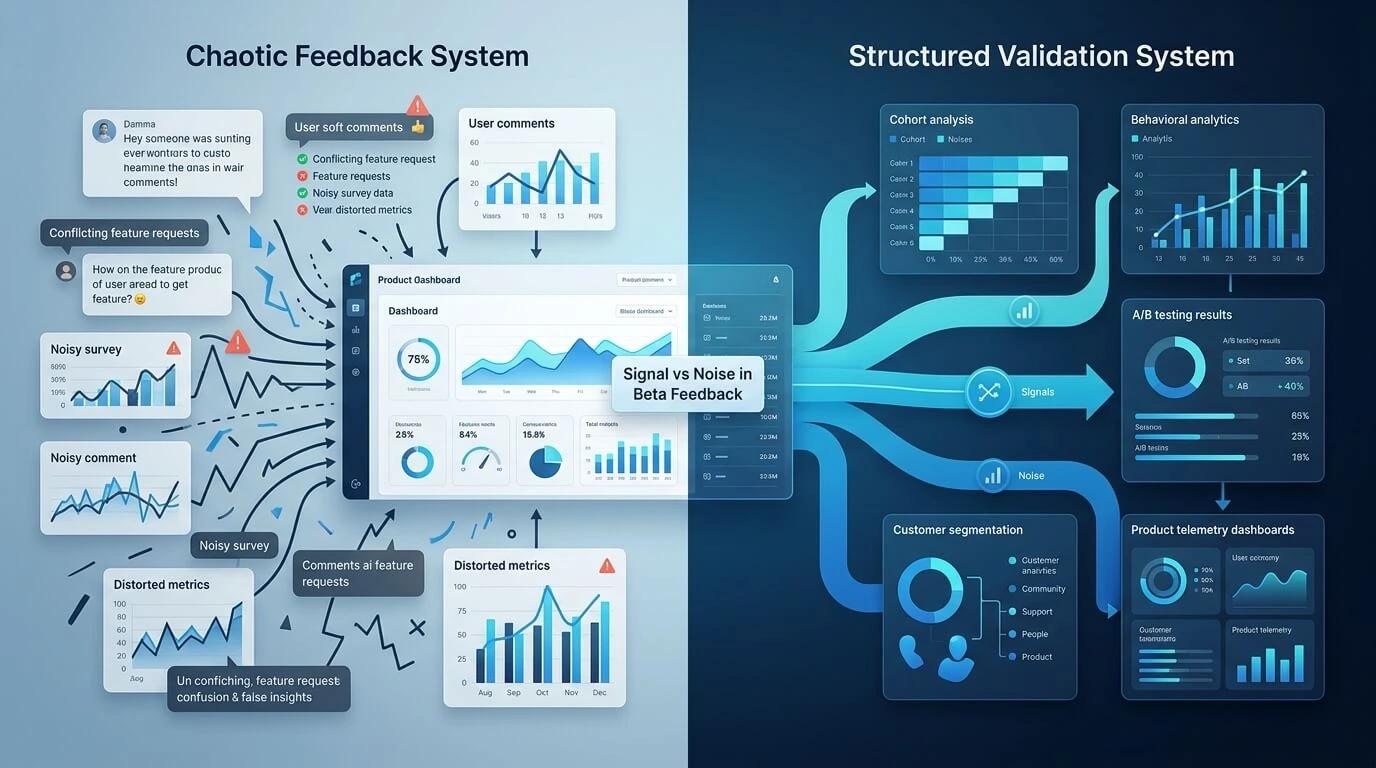
You've built an MVP. You've sent it to 20 beta users. You get back feedback that says everything is 'really great' and 'super useful.' So you ship it feeling confident—and then nobody actually uses it.
This happens because beta feedback loops are fundamentally broken at most early-stage companies. You're not actually measuring what matters—you're collecting polite validation from people who feel obligated to be nice. They're not your real users. They're friendly humans who've agreed to test something because you asked nicely. The gap between what they say in a feedback call and what they'd actually pay for is enormous, and most founders never measure it.
At XenonDev, we've watched this pattern repeat across dozens of product builds. The founders who win aren't the ones who get the most positive feedback. They're the ones who've built validation systems that separate genuine signal from polite noise. This post shares the framework we use to help teams build beta feedback loops that actually predict market fit.
The Feedback Bias Problem: Why 'Great Job' Doesn't Mean Anything
Beta testers have a fundamental conflict of interest. They've volunteered to test your product, which creates a social obligation to be encouraging. They don't want to hurt your feelings. They know you've put work in. So they optimize their feedback for kindness rather than honesty.
This creates what we call the 'praise inflation problem.' When you ask a beta user 'What do you think?' the answer is almost always positive. But when you ask 'Would you pay for this?' or 'Would you recommend this to someone in your exact situation?' the answer frequently becomes silence or hedging. The first question measures politeness. The second measures actual value perception.
There's also a selection bias built into most beta testing. You're typically recruiting from your warm network—friends, LinkedIn connections, people who already like you or your ideas. These aren't representative of your real market. They're pre-filtered for friendliness and general openness to your vision. A random person in your target market might react completely differently, but you'll never know because you didn't test with them.
The Behavior vs. Opinion Gap: What Actually Predicts Product Success
Research on product-market fit shows a consistent pattern: what users say in interviews has almost no correlation with what they actually do. A user can tell you your product is 'amazing' and then never open it again. They can claim they'd 'definitely use' something and never sign up. Words and actions live in completely different universes.
The signal that actually matters is friction. Specifically: how many points of resistance did this user push through to get value from your product? Did they sign up, then immediately activate? Did they hit a confusing screen and bounce? Did they activate but never return? Did they use it once then disappear? These behavioral micro-moments reveal whether your product is genuinely solving a problem or whether it's just intellectually interesting to them.
This is why we structure beta feedback around observed behavior, not stated opinions. We track activation rates, feature usage patterns, session lengths, and return frequency. We watch where users drop off or struggle. We measure time-to-first-value. These metrics create a factual record that no amount of polite feedback can obscure. If 80% of beta users sign up but only 20% activate, you have a problem—no matter what they say in the feedback call.
Building a Real Validation System: Five Core Components
A real validation system replaces the feedback call with a combination of behavioral data, friction analysis, and targeted questioning. Here are the five components we implement for every beta program we run:
1. Behavioral Funnel Tracking (The Truth Layer)
Set up comprehensive event tracking before you send the product to a single beta user. Map out your critical user journey: signup → onboarding → first action → second action → return visit. For each step, track exactly how many users complete it and exactly how many drop off. This creates a behavioral baseline that tells you where users are struggling.
If your funnel looks like 100 signups → 40 activations → 15 active users after 1 week, you've immediately identified two major problems. First, 60% of users aren't activating. Second, 62.5% of users who do activate aren't returning. No feedback call reveals these issues more clearly than the numbers themselves. This is your actual validation data. Everything else is commentary.
2. Friction Mapping (Finding Where Dreams Die)
Identify the specific screens and workflows where users drop off. Use session recording tools to watch exactly what users do when they hit friction. Do they spend 3 minutes on a confusing screen then leave? Do they click the wrong button and get lost? Do they hit a form with too many fields and give up? These moments reveal the actual product problems, not the imagined ones.
Create a 'friction log' for your beta period. Every time a user bounces or slows down, document the exact moment and the probable cause. After 2 weeks of beta, you'll have a ranked list of friction points ordered by how many users hit them. Attack the top 3-5 before asking for more feedback. Removing friction is the fastest way to improve validation metrics.
3. Commitment-Based Questions (The Real Test)
When you do talk to beta users, ask questions that require commitment rather than opinions. Don't ask 'What do you think?' Ask 'If this cost $X per month, would you pay for it?' Don't ask 'Is this useful?' Ask 'Who else in your industry would want this and why?' Don't ask 'Would you recommend this?' Ask 'Would you introduce me to someone who'd benefit and take the time to explain why it's useful?'
Commitment-based questions filter out politeness. If someone won't introduce you to a prospect, they don't actually believe in your product. If they won't pay, they don't genuinely perceive value. These are binary signals. You get a yes or a no, not a long explanation of why it's 'really interesting but.' The hesitation and hedging are the actual data.
4. Comparative Feedback (Against Real Alternatives)
Ask users how your product compares to what they currently use (or how they currently solve the problem). This anchors feedback in reality. Instead of 'Is this intuitive?' ask 'Is this more intuitive than your current solution?' Instead of 'Does this solve your problem?' ask 'Does this solve it better than your current approach?' The comparison forces them to make a genuine judgment rather than offering generic praise.
Often you'll discover that users prefer their current solution, which is brutal feedback but incredibly valuable. It tells you that you haven't actually created meaningful improvement. That's the signal you need to hear. Without the comparison anchor, they'd just say 'It's great!' and you'd miss the fact that they see no reason to switch.
5. Velocity Metrics (Change Over the Beta Period)
Track how key metrics change from week to week of your beta. If activation rates are improving because you're fixing friction, that's signal. If they're flatting or declining, that's a different signal. Pay attention to velocity, not just absolute numbers. A team that improves from 30% activation to 50% to 65% is learning and iterating effectively. A team stuck at 40% activation across three weeks has hit a deeper problem.
Velocity tells you whether you're on a path to product-market fit or whether you're moving in the wrong direction. Positive velocity means your changes are working. Flat or negative velocity means you need to rethink something fundamental. This is your leading indicator that you should either keep iterating or pivot to a different problem.
Practical Implementation: A Beta Program Checklist
Here's exactly what we set up before launching a beta program:
Week 1 before launch: Implement complete event tracking (signup, activation, first action, second action, return). Set up a session recording tool. Create a Slack channel specifically for real-time feedback. Week 1 of beta: Invite your users. Track day-1 activation. Watch session recordings to identify immediate friction. Week 2-3: Fix top friction points. Track velocity on activation metrics. Run commitment-based interviews with 10% of active users. Week 4: Analyze full funnel. Compare to your target metrics. Decide whether to expand beta, pivot, or ship.
Red Flags: When Your Beta Feedback Loop Is Lying to You
Watch for these warning signs that your validation system is broken. If 95%+ of beta feedback is positive, you're probably collecting politeness, not truth. If users say it's great but activation rates are below 50%, you have a feedback-behavior gap. If you can't articulate your funnel numbers (signup → activation → retention) off the top of your head, you're not measuring what matters.
If users won't answer commitment questions (price, introduction, switch from current solution), they're being nice. If your friction log is empty after week 2, you haven't watched enough sessions or looked hard enough. If velocity metrics are flat across the entire beta period, something fundamental is broken—either your target market isn't real or your solution isn't solving the actual problem.
The worst red flag is this: shipping because the feedback felt good. Validation should feel uncomfortable at some point. If it doesn't, you're not being honest with yourself about what the data is showing. The discomfort of discovering problems is the whole point. That's the only way you get to a product people actually want.
Moving From False Signals to Real Product-Market Fit
The founders we work with who reach product-market fit aren't the ones who get the most positive feedback. They're the ones who've built validation systems honest enough to show them what's actually happening. They measure behavior, not opinions. They track friction, not praise. They ask commitment questions, not softball questions. And they iterate on velocity, not on sentiment.
This approach feels harsher than traditional feedback loops. It is. But harsh data is more useful than kind data. A 40% activation rate with a clear friction log is infinitely more actionable than a stack of positive feedback comments. A user who won't pay is giving you real information. A user who says it's 'really interesting' but never returns is also giving you real information—you're just trained to ignore it.
If you're about to run a beta, stop and implement these five components first. Track behavior. Map friction. Ask commitment questions. Compare to alternatives. Monitor velocity. Then sit with the discomfort of what the data tells you. That discomfort is where real product development happens. Everything else is just validation theater.