Why Your Product's Feature Prioritization Is Silent Killing Your Growth (And How to Build a Data-Driven Framework)
Most founders prioritize features based on noise, not impact. Learn how to build a scoring system that reveals which features actually move your metrics.
Aamir Sohail, Co-Founder, XenonDev
, 8 min read
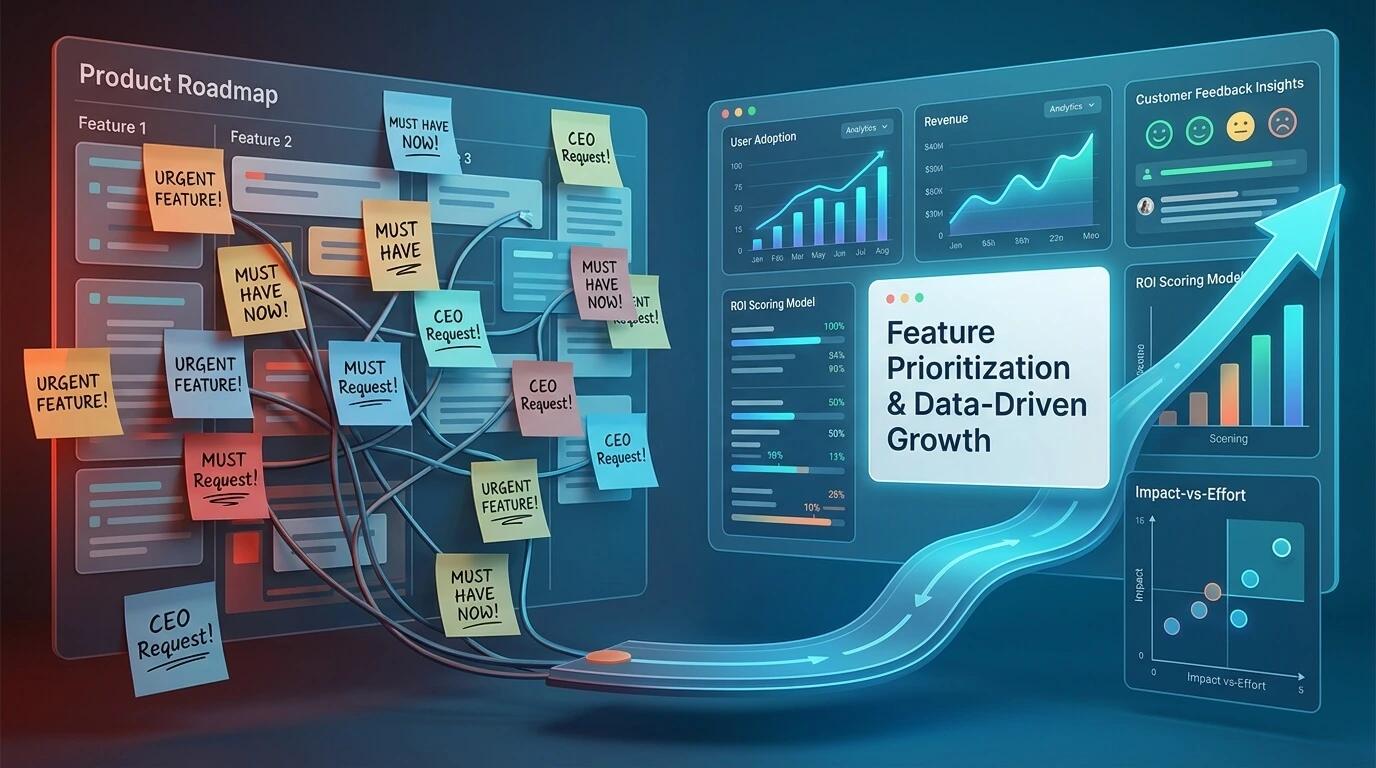
You're in your weekly planning meeting. Your head of sales wants a custom reporting dashboard. Your biggest customer is asking for integrations with their accounting software. Your product team believes the next big win is improving search performance. Your co-founder thinks you need a mobile app. Everyone has a reason their feature matters most.
By next month, you've built three of these features. Months later, you realize none of them moved your retention, conversion, or revenue metrics meaningfully. You built on emotion, not evidence.
This is the feature prioritization trap. Most products fall into it because teams use competing frameworks: HiPPO (highest-paid person's opinion), vocal customer feedback, gut instinct, or random urgency. What they're missing is a unified scoring system that connects each potential feature to your actual business metrics. At XenonDev, we've seen this pattern repeatedly across hundreds of product decisions, and we've built a framework that fixes it.
The Real Cost of Broken Feature Prioritization
Most teams don't measure the cost of building the wrong feature. They measure time spent, not opportunity cost. If you spend 6 weeks building a feature that increases feature adoption by 5%, but your real problem is that 40% of users churn in week 2, you haven't solved anything. You've just delayed solving what actually matters.
Here's what we've observed: teams with no prioritization framework build 2-3 major features per quarter. Maybe one lands. The other two are code debt within a year. Teams with a weak framework (like 'what do our sales team ask for') build features that feel good short-term but don't compound growth. Teams with a real framework build fewer features, but each one moves the needle on at least one critical metric.
The stakes are higher than you think. If you're early-stage, wrong prioritization costs you 3-6 months of momentum you can't afford to lose. If you're growing, wrong prioritization compounds: the features you didn't build today might have been the ones that unlock your next growth phase. Every quarter of misdirected engineering effort is a quarter closer to running out of runway or losing market position.
Why Popular Prioritization Methods Fail in Practice
The HiPPO Trap: Confident Opinions Aren't Data
When your CEO or founder makes the call, it feels decisive. But a CEO's intuition is built on 10% data and 90% narrative. They see one customer success story and assume it's a pattern. They remember the one complaint they heard and weight it like a thousand customer complaints. Worst part: no one questions it because authority creates false certainty.
The Vocal Customer Bias: Loudest Isn't Biggest
Your biggest customer or most engaged user cohort is visible and loud. But they're not representative. In one SaaS company we worked with, the top 3 customers were screaming for a feature. We built it. Usage was 8% across the entire user base. The silent 70% of users had a different problem nobody was listening to.
The RICE Framework Illusion: Scoring Feels Scientific But Isn't
RICE (Reach, Impact, Confidence, Effort) is popular because it looks objective. But the inputs are subjective estimates. 'How many users will this reach?' Nobody knows. 'What's the impact?' They guess. Garbage in, garbage out. We've seen teams spend hours scoring features with RICE only to pick the same feature they would have picked intuitively, with just more meetings along the way.
The Framework That Works: Data-Driven Feature Scoring
Instead of opinions about features, we anchor to your actual product metrics. Every feature should tie to one of these: improving activation (getting new users to value), improving retention (keeping users coming back), improving revenue per user, or reducing churn. Nothing else matters if these four aren't moving.
Step 1: Map Your Current Bottleneck (The Honest Diagnosis)
Pull your metrics for the last 90 days: activation rate (% of signups who hit their 'aha moment'), day-30 retention, monthly churn rate, and revenue per active user. Whichever metric is worst relative to your industry benchmark is your bottleneck. That's where your engineering effort should concentrate. If 50% of users churn in week 2, building advanced features for week 8 users is pointless.
Be ruthless here. Your co-founder's opinion about what you 'need' doesn't matter. The data is the diagnosis. If you're spending time building advanced features when your activation is 20% below benchmark, you're treating a symptom, not the disease.
Step 2: Estimate Real Impact (Not Opinion, Actual Leverage)
For each candidate feature, ask: 'What % of our bottleneck metric will this move?' If your activation is 20%, and you build a feature you think will improve it to 22%, that's a 10% relative improvement (2 percentage points / 20% baseline). Don't estimate 'we think 40% of users will use this.' Instead ask: 'Of users who churn in week 2, how many fail because of this specific missing feature?' Real data beats opinion. User research, support tickets, and session recordings tell you which features block real value, not which ones 'would be nice.'
Step 3: Calculate the Effort Score (Be Brutally Honest)
How many weeks of engineering time? Include design, QA, and launch. Then include hidden costs: if you ship this feature, what technical debt do you create? Will it slow down future iterations? If a feature takes 8 weeks and creates 2 weeks of ongoing maintenance, the real cost is 10 weeks. Your engineering lead will overestimate timelines (that's professional caution). Add 20% to their estimate. Underestimation kills more products than overestimation.
Step 4: Calculate Your Score (Impact / Effort = Priority)
This is simple: expected metric improvement / engineering weeks = score. A feature that improves your bottleneck metric by 15% in 4 weeks scores 3.75. A feature that improves it by 5% in 8 weeks scores 0.625. You don't need to pick the highest-scoring feature (sometimes there's strategic value in shipping something smaller for momentum), but you should never pick a low-scoring feature unless you have a defensible reason beyond 'the customer asked for it.'
Build a simple spreadsheet. Feature name, estimated metric improvement, engineering effort (weeks), score. Rank by score. That's your roadmap. Not committees, not politics, not HiPPO. Math.
How to Handle Pressure (The Politics of Prioritization)
Your sales team will push back. 'This customer is about to close a $50K deal if we build X.' Your biggest customer will demand special features. Your co-founder will have a vision. This is where discipline matters. If the feature doesn't score high enough to make the list on merit, it needs to be negotiated differently: longer sales cycle, price premium, or a separate module.
Make the framework transparent. Show your entire team the scoring system. Explain why Feature A ranks above Feature B. When sales understands that you're maximizing for product health metrics (not arbitrary opinions), they stop fighting. Sometimes they even help you gather better data about feature impact. And when they ask for a high-effort, low-impact feature, they can see why it doesn't make the cut.
One caveat: revenue matters. If one customer paying $10K/month specifically blocks your ability to close them, you might build that feature even if the score is low. But be explicit: 'This is a customer acquisition cost of $X to land this deal.' If the CAC is reasonable, do it. If it's not, don't let one customer distract you from building for the 100 you're trying to land.
Running the Feedback Loop: Measuring What Actually Happened
You shipped Feature A. You estimated it would improve retention by 10%. Two weeks post-launch, you're tracking adoption (is anyone using it?) and impact (is it actually moving retention?). If adoption is below 20%, your estimate was wrong. If adoption is good but retention didn't move, your assumption was wrong. Both teach you something critical for your next estimate.
Track this. After every major feature launch, compare your predicted impact to the actual impact. This isn't about blame; it's about calibration. Teams that consistently predict high impact and deliver low impact are either poor at estimation or solving the wrong problems. After 4-5 cycles, your estimates get much better. That learning curve is worth the investment.
We recommend publishing a monthly 'Prioritization Report' to your team: what you built, what impact you predicted, what actually happened, and what you learned. This keeps everyone accountable and makes the decision-making process transparent. It also makes it much harder for people to push low-scoring features because they can see in real time which prioritization decisions were right.
Moving From Guessing to Knowing: Your Next Step
The framework works because it removes emotion from the equation. You're not debating whether Feature A 'feels important.' You're looking at impact per week of effort. That changes conversations. People who were arguing for their pet project suddenly become allies in prioritizing high-impact work when you show them the data.
Start this week. Identify your bottleneck metric. List 8-10 features you're considering. Estimate impact and effort for each. Calculate scores. Look at what ranks. If the top-scoring features surprise you, dig into why. Maybe your estimates are wrong. Maybe you need better data about what blocks your users. That investigation is where real product insight comes from.
At XenonDev, we use this framework with every product team we work with. It's the single most effective decision-making tool we've found for connecting engineering effort to business outcomes. If your team has been building on instinct, this framework is the thing that changes your velocity and your results. Start now. Your roadmap—and your growth—depend on it.