How to Go From Idea to Launched Product in 10 Weeks Without a Technical Co-Founder
You don't need a technical co-founder to launch a product. The exact process we use to take non-technical founders from idea to prod-ready product in 10 weeks.
Abdul Ahad Akram, CEO & Founder, XenonDev
, 6 min read
Introduction
One of the most persistent myths in startup culture is that you need a technical co-founder to build a real product. You've heard the advice: find your CTO first, don't hire an agency, build in-house from day one.
It's advice that makes sense in theory. In practice, it leads to thousands of founders waiting years for the right technical partner while their idea sits in a Notion doc getting stale.
The truth is that the right development partner — not a factory, not a freelancer marketplace, but a genuine technical partner — can take you from idea to launched product faster than most founding teams can hire their first engineer.
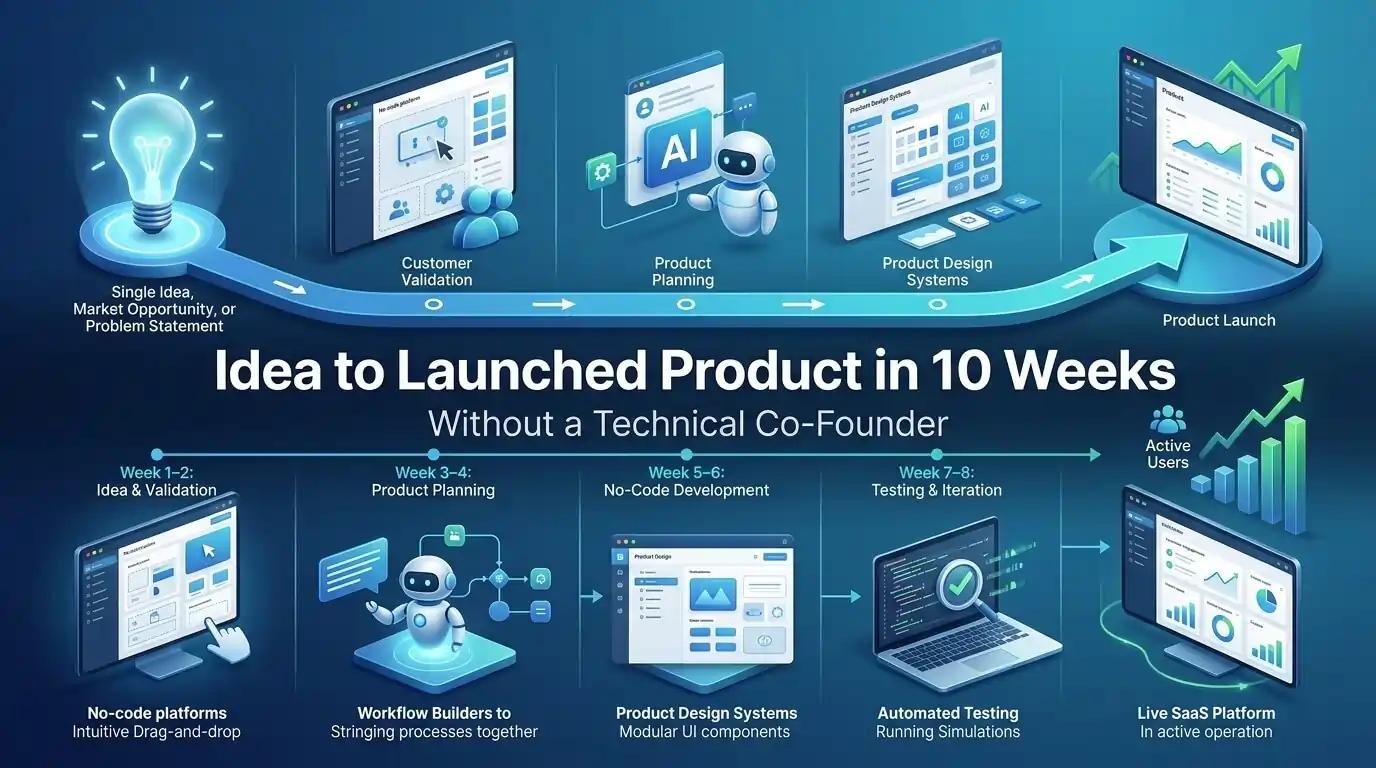
This is the exact process we use at XenonDev to do it in 10 weeks.
Week 1–2: Discovery and Scoping
The most expensive mistakes in product development happen before a line of code is written. They happen when teams skip straight to building without properly defining what they're building, who it's for, and what success looks like.
Our first two weeks are entirely dedicated to discovery. This means:
User story mapping — We work with you to define every action a user can take in your product, mapped to the outcomes they're trying to achieve. This isn't a features list. It's a structured understanding of how your product creates value.
Scope definition — We draw a clear line between what's in the MVP and what's not. The MVP is not a stripped-down version of your full vision. It's the smallest version of your product that delivers the core value proposition to your first users. Everything else is version two.
Technical architecture — We define the tech stack, the data model, the integration points, and the infrastructure approach before writing a line of code. Decisions made here will shape the product for years. We take them seriously.
Success metrics — We define what a successful launch looks like before we build. What does adoption look like? What does retention look like? What's the one metric that tells you the product is working?
By the end of week two, you have a scoped product definition, a technical architecture document, and a build plan with clear milestones. No surprises.
Week 3–5: Design and Prototyping
Design is where most agencies waste time and most founders get frustrated. Long design phases that produce beautiful mockups that never get built. Endless revision cycles that add weeks without adding value.
We compress design into three focused weeks:
Design system first — We establish your visual language — colors, typography, spacing, components — before designing any screens. This means every screen we design is consistent by default, and every screen we build is consistent by default.
Core user flows only — We design the critical paths first. Onboarding, core value delivery, key actions. We don't design edge cases or admin screens in the MVP. Those come later.
Interactive prototype — By the end of week five, you have a clickable prototype of your core user flows. This is the most important artefact we produce. It lets you test your assumptions with real users before we write a single line of production code.
Founder feedback loop — We review with you at the end of every week. Not a formal presentation — a working session where we look at what we've built together and make decisions.
Week 6–9: Build
Four weeks of focused development. This is where most agencies slow down and most projects go wrong. Scope creep, unclear requirements, communication breakdowns.
We avoid these by doing three things:
Weekly demos — Every Friday, you see working software. Not a status update, not a progress report — a live demo of what was built that week. This keeps the build honest and gives you continuous visibility.
No surprises policy — If something is taking longer than expected, you know immediately. If we discover a technical constraint that affects the plan, we tell you the same day. No end-of-sprint surprises.
Scope discipline — When new ideas come up during the build — and they always do — we document them for version two rather than folding them into the current build. This is the single most important discipline in shipping on time.
By the end of week nine, you have a production-ready product. Not a demo, not a staging environment — a real product running on real infrastructure, ready for real users.
Week 10: Launch Preparation
The final week is about making sure everything is in place for a successful launch:
Performance and security audit — We test load times, security headers, authentication flows, and data handling. Everything that matters for a production environment.
Monitoring and observability — Error tracking, uptime monitoring, and performance monitoring are configured before launch. You'll know immediately if something goes wrong.
Documentation handover — You receive full technical documentation — architecture overview, deployment guide, environment variables, third-party integrations, and a runbook for common operational tasks.
Launch support — We're available during launch week. If something breaks, we fix it. That's not a paid support tier — it's part of how we work.
What You Actually Need Instead of a Technical Co-Founder
You don't need someone who can write code. You need someone who can make good technical decisions, communicate clearly about technical constraints, and take genuine ownership of the product's quality.
That's what a real development partner does. The difference between a development partner and a development vendor is accountability. A vendor delivers what you spec. A partner tells you when your spec is wrong.
At XenonDev, we push back. We'll tell you when a feature is unnecessary for the MVP. We'll tell you when a technical approach has long-term risks. We'll tell you when a timeline is unrealistic. That's not obstruction — it's the honest engagement that gets products shipped and keeps them running.
The Non-Technical Founder's Checklist
Before you start a product build, make sure you can answer these questions:
What is the single most important thing your product does for your user? If you can't answer this in one sentence, you're not ready to build.
Who are your first ten users? Not your target market — ten specific people you can call and ask to use your product. If you don't know who they are, you're building for an abstraction.
What does success look like at the end of week one post-launch? Not month six — week one. What adoption, what feedback, what signals tell you the product is working?
What are you explicitly leaving out of the MVP? A good MVP definition includes a clear list of things you've decided not to build yet. If you don't have this list, your scope will expand until it's unshippable.
What's your runway? A 10-week build is only useful if you have enough runway to act on what you learn after launch. If you're spending your last money on the build, the economics don't work.
Conclusion
The 10-week timeline is real. We've done it for B2B SaaS platforms, FinTech products, LegalTech tools, and consumer apps. It requires discipline, clear decision-making, and a development partner who takes the timeline as seriously as you do.
You don't need a technical co-founder. You need a technical partner who shows up like one.
Thinking about building your product? Book a free strategy call — we'll tell you honestly whether we're the right fit and what a build would look like for your specific idea.