The Hidden Cost of Shipping Too Fast: Why Your MVP's Technical Debt Will Cost 3x More to Fix Later
Speed matters for MVPs, but cutting corners on architecture creates exponential costs later. Learn where to invest quality and where to move fast.
Aamir Sohail, Co-Founder, XenonDev
, 8 min read
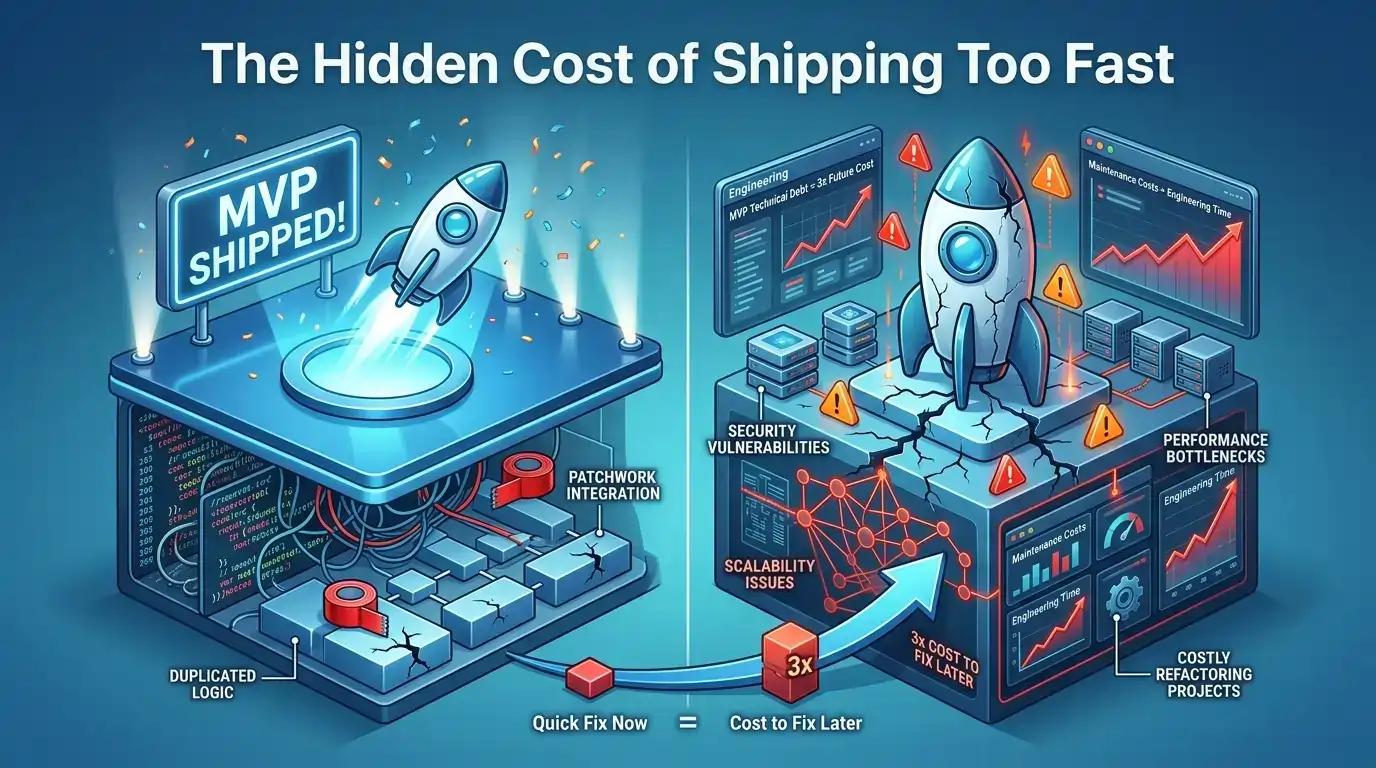
Every founder we work with at XenonDev hears the same advice: move fast, ship quick, learn from users. It's good advice. The problem is that 'moving fast' has become code for 'cut every corner and apologize later.' We've watched founders ship MVPs in weeks that took 6 months to untangle, costing hundreds of thousands in wasted engineering time and lost user trust.
The real cost of technical debt isn't measured in launch speed. It's measured in how long your product stays broken, how quickly your team burns out, and how many users you lose before you can fix it. We've calculated that for every dollar saved by skipping architecture decisions early, founders spend $3 to $5 fixing it later. This post breaks down exactly where that math comes from and which corners you can safely cut without destroying your product.
The Three Layers of Technical Debt: Which One Actually Matters
Technical debt isn't binary. There are layers, and they have wildly different costs when you eventually have to pay them down. We categorize them into three buckets: visible debt, hidden debt, and foundational debt. Understanding the difference changes everything about which shortcuts are acceptable.
Visible Debt (UI/UX shortcuts): Cheap to Fix
This is the easiest category. Visible debt includes clunky interfaces, missing error messages, inconsistent styling, and workflows that feel rough around the edges. A user sees this immediately and feels it, but it's usually cheap to fix. If your MVP has a button that doesn't match your brand colors or a form that doesn't validate properly, that's visible debt.
The cost to fix visible debt later is roughly 1x. A designer and frontend engineer can usually tidy this up in a sprint or two. This is where we tell founders it's completely fine to cut corners. Ship a basic UI, prove your concept works, and polish once you have revenue or validated demand. Users will forgive a rough interface if your product solves a real problem. They won't forgive instability or broken core features.
Hidden Debt (Data structures, API design, third-party integrations): Moderate to Expensive
Hidden debt lives inside your product architecture where users can't see it, but it cascades through your system like a virus. This includes database schema decisions, how you structure your data models, how your backend APIs are organized, and which third-party services you choose. These decisions seem invisible during MVP phase, but they determine whether your product stays nimble or becomes a house of cards as you scale.
We've seen founders choose a payment processor during MVP phase that handles their first 10,000 users fine, then discover it doesn't support the recurring billing model they need at scale. They have to migrate everything—data, live transactions, historical records—while their product is in production. That's a 3-4 week project for two engineers that could have been prevented with 4 hours of research upfront. The cost to fix hidden debt later is typically 2-3x the cost of doing it right initially.
Foundational Debt (Authentication, scalability, security, data privacy): Most Expensive
Foundational debt is where corners become catastrophes. This category includes authentication and authorization patterns, how you handle sensitive data, whether your infrastructure can scale, and whether you've built in audit trails or compliance tracking. These aren't visible to users, but they determine whether your product is trustworthy, secure, and viable for enterprise customers.
One of our clients shipped an MVP without proper role-based access control. Six months later, when they wanted to move upmarket to larger companies, they discovered their security model was insufficient. Every customer wanted different permission levels, audit trails, and data isolation. What should have taken 2 weeks of architecture work during MVP phase took 8 weeks of refactoring while the product was live and customers were already using it. The cost to fix foundational debt is 4-6x the upfront cost, plus you lose competitive momentum while your team is in the weeds.
The Math Behind the 3x Cost Multiplier
Where does the 3-5x multiplier actually come from? It's not magic. It's compound friction. When you defer architectural decisions, you're not just delaying work—you're multiplying it across three dimensions: scope explosion, code coupling, and team context switching.
First, scope explodes. A quick database schema during MVP works for 50 users. But when you hit 5,000 users, you need data normalization, indexing strategies, and query optimization. What looked like a simple table now needs to be restructured. You can't just add a column—you need to migrate live data without downtime. That 2-hour decision becomes a 40-hour project.
Second, code coupling compounds the problem. During MVP, you hard-code authentication checks into 15 different endpoints because you're moving fast. Six months later, you need to add SSO support. Now you have to find, audit, and rewrite those 15 endpoints instead of calling a single authentication service. Every shortcut you took created dependencies that spread like roots through your codebase.
Third, team context switching kills your velocity. When you defer architectural work, you're forcing your team to context-switch between feature development and fixing broken foundations. An engineer spends 3 hours understanding why data migration is failing, loses focus on the feature they were building, then spends another hour getting back into flow. Multiply that across a team and a year, and you've lost thousands of hours of productive engineering.
The Founder's Framework: What to Build Right, What to Skip
This is the practical bit. We use a simple two-axis framework with every founder: 'How visible is this to users?' and 'How hard is it to change later?' The intersection tells you whether to invest or defer.
Invest In (Hard to Change Later + Critical Impact)
Build authentication and authorization properly from day one. Your MVP needs secure password handling, session management, and a clear permission model—even if you only have 3 user types. Spend a full sprint getting this right. Use OAuth or industry-standard libraries, not custom code. This foundation determines whether you can serve enterprise customers or self-serve millions of users later.
Make database schema decisions thoughtfully. You don't need a perfect database design, but you do need a clean one. Spend time with your architect or senior engineer mapping out data relationships, normalization rules, and query patterns. A bad schema is expensive to migrate at scale. Choose between SQL and NoSQL based on your actual use case, not convenience.
Plan your third-party integration strategy upfront. If you'll eventually need payment processing, compliance tracking, or analytics, research the providers before you build. A hasty choice of payment processor or CRM platform will lock you into technical decisions you can't easily escape later.
Defer (Visible to Users + Easy to Change)
Ship with a basic, functional interface. Your MVP doesn't need beautiful animations, a sophisticated design system, or pixel-perfect spacing. It needs to be clear and usable. A product manager and one frontend engineer can polish your MVP's UI in 2-3 weeks once you have real feedback from users. Don't spend 6 weeks perfecting the design of features users might not want.
Skip advanced reporting and analytics. Your MVP doesn't need a dashboard with 20 different visualizations. Build the core feature first. Once you understand how users behave, add analytics. If you eventually need sophisticated reporting, it's straightforward to add—it doesn't touch your foundational architecture.
Ship limited notification and communication features. Your first version doesn't need email marketing, SMS, Slack integrations, and webhooks all at once. Build the core workflow. Add integrations as customers ask for them. These are modular features that won't destabilize your product.
Plan Ahead (Hard to Change + Not Immediately Visible)
Don't skip infrastructure thinking. You don't need a complex DevOps setup, but you do need to know how your app will scale. Can you handle 10x your current traffic? Is your hosting provider appropriate for your use case? Will your database collapse at 100,000 records? These questions have architectural answers that are hard to change at scale.
Build compliance and security groundwork early if your product handles sensitive data. If you're in healthcare, finance, or handle personal data, don't defer security. Audit trails, data encryption, and compliance controls need to be part of your architecture from the start. Retrofitting HIPAA or SOC 2 compliance is incredibly expensive.
Real Examples: What We've Seen Go Wrong (And Right)
A B2B SaaS founder we worked with shipped an MVP with hard-coded user roles. They wanted to move fast, so they didn't build a permission system—just coded 'is_admin' checks scattered throughout their codebase. Six months later, when their first enterprise customer wanted custom roles and permission hierarchies, the refactor took 6 weeks of engineering time and delayed their entire roadmap. That shortcut cost them $180,000 in lost engineering velocity and a delayed product launch.
Another founder we work with did the opposite. They invested 3 weeks during MVP phase on proper authentication, role-based access control, and API design. Their MVP was slightly slower to ship—10 weeks instead of 7. But when they started moving upmarket to enterprise customers and needed SSO, fine-grained permissions, and audit logs, they already had the architecture in place. Adding those features took 2 weeks instead of 8. They were able to close enterprise deals 6 weeks earlier than they otherwise would have, and their engineering team stayed focused on building features instead of refactoring foundations.
The pattern is consistent across every project we see: a few hundred dollars spent on the right architectural decisions during MVP saves tens of thousands later. It's not about perfectionism. It's about understanding which decisions have downstream costs and which ones don't.
How to Make These Decisions in Your MVP Planning
Before you start building, run through this checklist with your technical team. For each major system in your product, ask: Is this decision reversible? If we get this wrong, how expensive is it to fix at scale? Do we have enterprise customers or compliance requirements that force us to build this right? The answers determine whether you architect properly or move fast.
Document your architectural decisions, even the quick ones. You don't need a 50-page architecture document, but your team should know: why you chose a particular database, what third-party services you integrated with and why, what your authentication model assumes, and what scaling constraints you're aware of. This document isn't for investors—it's for your future self when you're triaging why a feature is taking longer than expected.
Get a second opinion from someone who has shipped products before. If you're a first-time founder, spend $5,000 on a technical advisor or consultant to review your MVP architecture before you build. That might sound expensive, but it's insurance against $50,000 worth of refactoring. We've seen founders save months of work by catching foundational decisions during planning instead of during production firefighting.
The Verdict: Speed Doesn't Mean Shortcuts Everywhere
The fastest way to ship a product isn't to cut every corner. It's to cut the right corners and invest thoughtfully in decisions that compound. Your MVP needs clean authentication, a sensible database schema, and a scalable infrastructure foundation. It does not need pixel-perfect UI, comprehensive reporting, or every integration you'll eventually want.
At XenonDev, we build products that founders can scale. That means spending the right amount of time on foundations during MVP phase so you're not haunted by technical debt decisions six months later. It's the difference between shipping in 8 weeks and still being productive 6 months down the line, versus shipping in 6 weeks and spending the next 6 months in reactive firefighting mode.
Ask yourself this before you defer a decision: Will this cost 3x more to fix later? If the answer is yes, build it right now. If the answer is no, cut the corner and ship. That single question will save you more time and money than any productivity framework or development methodology ever will.