Why Your Product Launch Timeline Is Wrong (And How Founders Miscalculate It)
Most founders underestimate launch timelines by 40-60%. We've analysed real project data to show you where the miscalculations happen and how to build realistic roadmaps.
Abdul Ahad Akram, CEO & Founder, XenonDev
, 8 min read
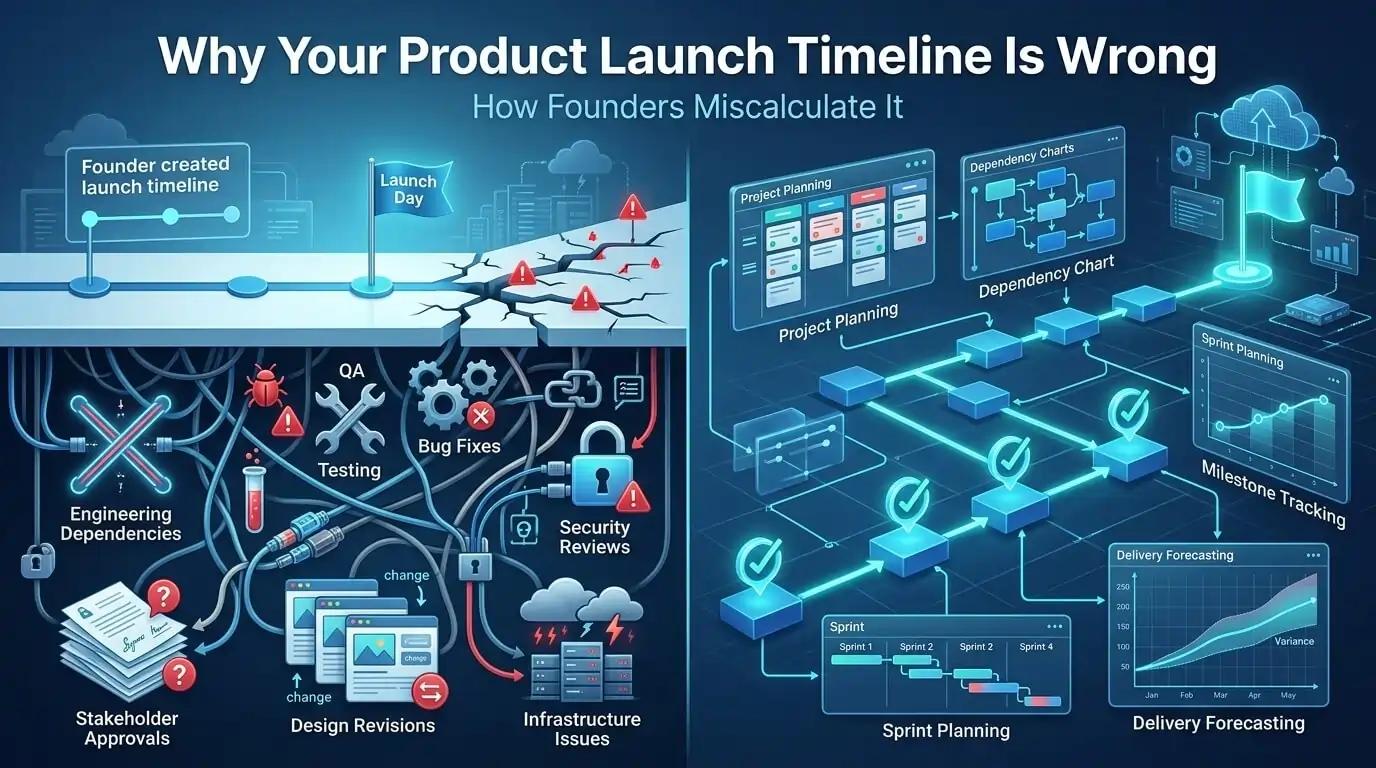
You've probably heard this before: a founder tells their investors or stakeholders that they'll launch in 12 weeks, and 24 weeks later the product still isn't live. The gap between estimated and actual timelines isn't a sign of incompetence. It's a systematic problem baked into how founders think about product development.
Over three years of building products for founders across SaaS, fintech, and enterprise spaces, we've noticed a pattern. Timelines fail not because developers are slow, but because founders systematically exclude entire phases of work from their estimates. They count feature development but forget about integration complexity, third-party dependencies, security reviews, user testing iterations, and the countless unknowns that emerge once real building starts.
This post isn't about working faster. It's about estimating honestly. We'll walk you through the exact phases founders miss, show you where timing typically breaks down, and give you a framework to build timelines that actually hold.
The Five Hidden Phases Founders Never Budget For
When founders estimate timelines, they typically think: 'Build feature A, build feature B, build feature C, launch.' This is honest but incomplete. Between each of these sits invisible work that consumes 30-50% of your total timeline but rarely appears in the initial roadmap.
1. Architecture and Infrastructure Setup (Typically 2-4 Weeks)
Before a single feature ships, your team needs to decide: What cloud provider? What database architecture? How do we handle authentication? What's our CI/CD pipeline? Most founders assume this happens in a day or two. In practice, poor infrastructure decisions in week one create cascading problems in weeks 6-10 that force rewrites.
We've seen founders choose a database that seemed perfect for month one but becomes a bottleneck at scale, forcing a painful migration mid-project. We've watched teams build without proper logging infrastructure, then spend weeks debugging production issues that should have been caught in development. Infrastructure isn't glamorous, but it's foundational. Budget 15-20% of your timeline here before the first feature line gets written.
2. Third-Party Integration and API Complexity (Variable, Often 3-6 Weeks)
Almost every product needs to talk to something external: Stripe for payments, Twilio for SMS, AWS for storage, or legacy systems your customers already rely on. Founders often estimate this as 'a few days,' but integration complexity is almost always underestimated. Payment processing alone—handling webhooks, reconciliation, error cases, PCI compliance—can take 2-3 weeks if done properly.
Then there's the variance. Some APIs are straightforward REST endpoints with good documentation. Others require custom integration work, have rate limiting that forces architectural changes, or have outdated documentation that wastes days of debugging. If you're integrating with legacy enterprise systems, add another month. Build a 'integration buffer' into your timeline: it's not pessimism, it's realism.
3. Security, Compliance, and Code Review (2-4 Weeks, Non-Negotiable)
If your product handles sensitive data—financial information, personal data, health records—security work isn't optional nice-to-have, it's foundational. This includes encryption, access controls, audit logging, vulnerability scanning, and security testing. Founders in regulated industries (fintech, healthcare, legal tech) often know this. Everyone else tends to underestimate it or defer it until after launch, which is expensive and risky.
Code review and testing deserve their own line item too. If you're building with a small team and rushing, code review happens on Friday afternoon and takes 10 minutes. If you care about reliability, it's a serious process. A single security vulnerability discovered post-launch costs 5-10x more to fix than if caught during development. Budget security and code review into your baseline timeline, not as an afterthought.
4. User Testing and Iteration Cycles (2-3 Weeks Minimum)
The timeline breaks down hardest here. Founders think: 'Build product → Show to users → Launch.' Reality is: 'Build product → Show to users → Realize entire sections are confusing → Redesign flow → Code changes → Test again → Find edge cases → Fix bugs → Test again.' A single usability finding can require a week of development work.
We recommend testing with 5-8 real users from your target market before launch, with cycles that include: observation, feedback collection, prioritization of changes, development, and re-testing. This typically takes 2-3 weeks in parallel with other work, but often stretches to 4-5 weeks when findings are significant. The math is simple: would you rather discover a critical UX problem in testing or after launch when thousands see it?
5. Documentation, Deployment, and Launch Preparation (1-3 Weeks)
This is the phase that gets cut when timelines slip. But skipping it guarantees problems. You need: API documentation for integrations, onboarding guides for early users, a support runbook for your team, deployment scripts that work reliably, rollback plans for when things go wrong, and monitoring set up before your first user touches the product. A week of careful preparation here prevents three weeks of firefighting later.
Launch day itself often exposes issues: rate limiting problems you didn't anticipate, edge cases in your data processing, features that work in controlled testing but fail at scale. The team needs a launch checklist, communication protocols, and bandwidth to respond. If you're exhausted by the time you launch, you won't have the energy to handle real problems effectively.
Where Estimates Break: The Compounding Effect of Unknowns
Even with the five phases above accounted for, timelines still slip. Why? Because estimates assume stable conditions, but product development doesn't work that way. Each phase surfaces new unknowns that ripple forward.
A developer discovers mid-project that the chosen technology doesn't support a required feature, forcing a pivot. A stakeholder requirement changes based on new market feedback. An external API you depended on becomes unreliable, forcing workarounds. These aren't failures—they're inevitable. The problem is founders don't budget for them. A realistic timeline includes 20-30% contingency for the unknown unknowns.
We've noticed this pattern repeatedly: a team estimates 12 weeks and adds no buffer. At week 8, they're 60% done, not 67% done. They discover a critical bug that takes two weeks to fix. They realize a feature needs redesign. The timeline suddenly becomes 16-18 weeks, and everyone acts shocked, even though the math was never realistic to begin with.
Building a Realistic Timeline: The Framework We Use
Here's how we approach timeline estimation with founders. This framework won't give you a perfect number—perfect numbers don't exist—but it will get you much closer to reality.
Step 1: Map Every Phase Explicitly
List out: infrastructure setup, feature development (broken down feature-by-feature), integrations, security work, testing, documentation, and launch preparation. Don't hide anything. Your timeline should be granular enough that each item is estimable. 'Build payments' is too vague. 'Implement Stripe integration, including webhook handling, reconciliation logic, error cases, and PCI documentation' is clear.
Step 2: Estimate at the Team Level, Not the Task Level
A task estimate of '3 weeks for one developer' doesn't account for pull request review, context switching, meetings, or the fact that developers aren't productive 100% of the time. We use calendar weeks of team capacity: if you have two full-time developers, you have roughly 80 productive hours per week (accounting for meetings, interruptions, and normal inefficiency). Divide your estimated task hours by your available weekly hours to get realistic timelines.
Step 3: Apply Realistic Multipliers for Complexity
A feature estimate of '5 days for basic dashboard display' might become '12 days for dashboard with real-time data sync, complex filtering, and performance optimization.' Use multipliers: straightforward features get 1x estimate; features with external dependencies get 1.5-2x; features with unknown unknowns or regulatory requirements get 2.5-3x. Be honest about which category each feature falls into.
Step 4: Add a Contingency Buffer (20-30%)
Your initial estimate is the best-case scenario where everything goes smoothly. Reality includes unexpected bugs, requirements changes, edge cases you didn't anticipate, and the inevitable time spent on things that seemed small but turned out to be complex. A 20-30% buffer is conservative for novel product work. We typically use 25% as a baseline.
Step 5: Break It Into Milestones With Clear Deliverables
Instead of one long estimate, break into 2-4 week milestones with specific deliverables: 'Week 1-2: Infrastructure, authentication, database schema.' 'Week 3-4: Core user features and initial integrations.' 'Week 5-6: Testing, refinement, documentation.' This lets you track progress against reality and adjust mid-project instead of discovering a massive gap at week 11.
What Bad Timeline Estimates Cost You
Missing your timeline by a month sounds like a minor slip. It's not. The costs compound across multiple dimensions.
Financially: if you budgeted $200k for a 12-week build and it takes 16 weeks, you've burned $266k. But the cost extends beyond development. Your early customers are delayed. Your go-to-market timeline slips. Competitors launch while you're still building. Revenue that should have started in month four starts in month six. For venture-backed companies, this means burning additional runway. For bootstrapped founders, it means running out of money.
Organizationally: missing timelines twice demoralizes teams. Missed deadlines create doubt about leadership credibility. Early employees start wondering if they joined a doomed venture. Investors lose confidence. Recruiting becomes harder when you're no longer a 'on-time, focused' company but a 'always shipping late' one.
Technically: when timelines slip, the temptation is to cut corners on the things that seemed optional: documentation, security work, code review, testing. This creates technical debt that costs 3-5x more to fix later. A 16-week project with poor documentation and incomplete security testing becomes an 8-week refactor project three months post-launch. You're paying twice: once for the rushed work, again for the cleanup.
Making the Realistic Timeline a Feature, Not a Bug
Founders often resist realistic timelines because they feel longer than hoped. A founder wants to believe they'll ship in 10 weeks; hearing 14 weeks feels like failure. But a realistic timeline is actually an advantage. It's the only timeline that lets you set expectations with investors, stakeholders, and your team that you can actually meet.
When you commit to 14 weeks and ship in 13, you look like a hero. When you commit to 10 weeks and ship in 14, you look unprepared. The wall clock time is the same, but perception and momentum are completely different. Use the realistic timeline to build trust, show execution discipline, and give your team permission to do quality work without panic.
A realistic timeline also surfaces trade-off conversations early. If your true timeline is 18 weeks but you're fundraising in 10 weeks, you have clarity about what that means: you'll need to scope down features, bring in additional developers, or adjust your fundraising timeline. These are real choices with real consequences, but at least you're making them from a position of honesty rather than discovering the problem when you're already late.
The timeline estimate that feels uncomfortable—the one that's longer than you hoped—is usually the honest one. At XenonDev, we've learned that getting to a realistic timeline and then protecting that timeline is one of the best predictors of whether a product launch succeeds. It's not about being slow. It's about being honest, planning completely, and respecting the actual complexity of building something people want to use.