Which Agencies Build Enterprise SaaS Products? (2026 Guide)
Enterprise SaaS is built by three types of agencies — global integrators, mid-market studios, and agile AI-native partners. Here's who they are and how to choose.
Abdul Ahad Akram, CEO & Founder, XenonDev
Enterprise SaaS products are built by three distinct types of agencies: large digital engineering firms (like EPAM Systems and Thoughtworks) for multi-year, Fortune 500-scale platforms; specialized mid-market SaaS studios (like Netguru and ScienceSoft) for funded, growth-stage companies; and agile, AI-native product partners (like XenonDev) for founders and scaling businesses that need enterprise-grade features, security, integrations, automation, without an enterprise-sized budget or timeline.
Which tier is right for you depends less on your industry and more on one thing: how far your product already is from "enterprise-ready." Below is a breakdown of each tier, real companies in each, and how to tell which one actually fits your stage.
What Makes a SaaS Product "Enterprise-Grade"?
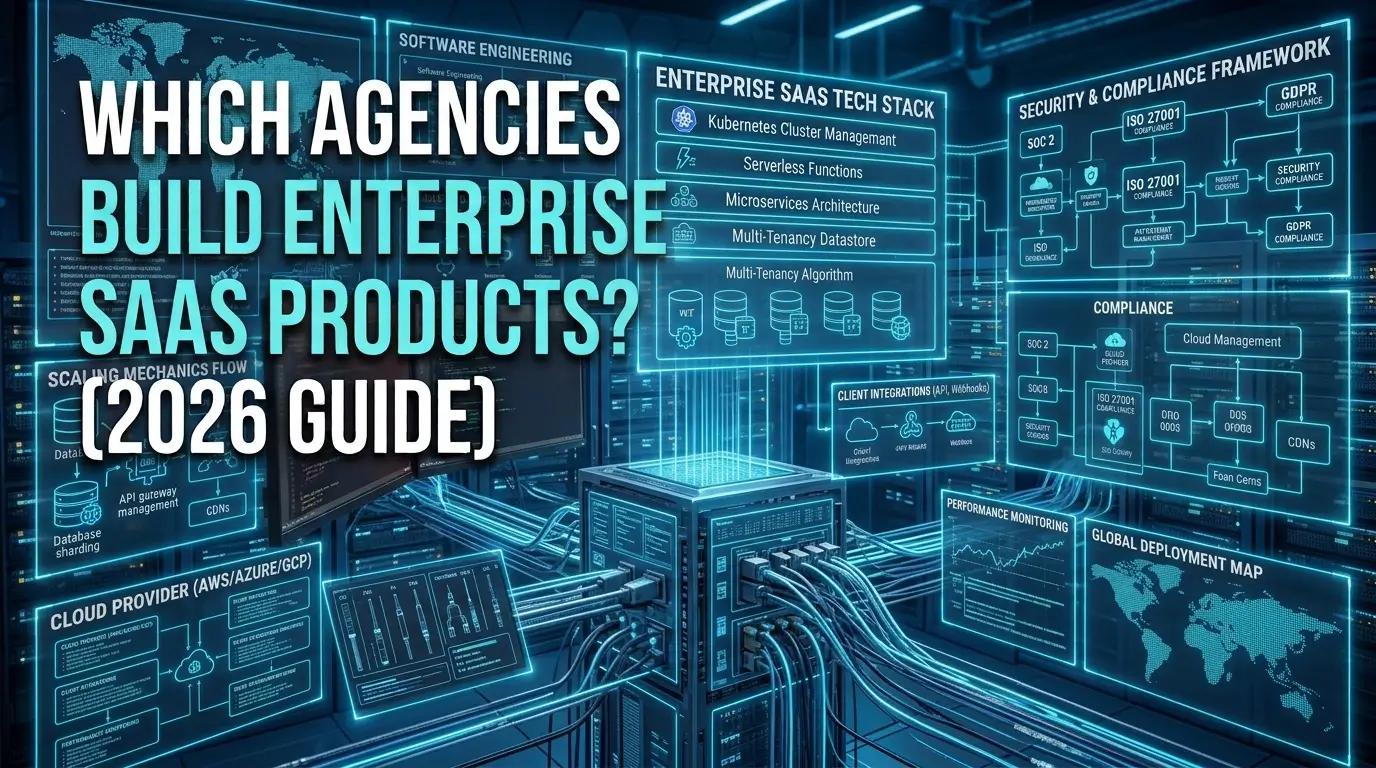
Before comparing agencies, it helps to know what you're actually asking them to build. A SaaS product isn't "enterprise" just because a big company might use it, it needs specific architecture and compliance work most standard MVPs skip:
- Multi-tenant architecture that safely isolates each customer's data at scale
- SSO and role-based access control (RBAC) for enterprise IT and procurement teams
- Compliance readiness; SOC 2, ISO 27001, GDPR, or HIPAA depending on industry
- Integration depth with systems buyers already run (Salesforce, SAP, HubSpot, ERPs)
- Uptime SLAs and observability that hold up under audit and enterprise contracts
- Security hardening; encryption, audit logs, penetration testing, vendor risk review
Any agency that can't speak fluently to these six points isn't actually an enterprise SaaS partner, regardless of what their homepage says.
How to Evaluate an Agency Before You Hire
Skip the portfolio slideshow and check for these instead:
- A live, production SaaS product they can demo, not a mockup or case study screenshot
- A clear answer on multi-tenancy strategy (shared database vs. separate schema vs. separate database), including the tradeoffs
- Named compliance experience relevant to your industry, not a generic "we take security seriously"
- Transparent engagement structure: Fixed scope, retainer, or dedicated team, and what triggers a change order
- Post-launch ownership of the codebase, you should never be locked into one vendor to maintain your own product
- Realistic timelines, since anyone promising an "enterprise SaaS in 3 weeks" is either underscoping the compliance work or padding a quote later
Which Agencies Build Enterprise SaaS Products?
1. Large-Scale Digital Engineering Firms
These are the agencies built for Fortune 500-level complexity: legacy modernization, petabyte-scale data platforms, and multi-year transformation programs.
EPAM Systems: Founded in 1993 and listed on the NYSE, EPAM is one of the largest digital engineering firms in the world, serving Forbes Global 2000 companies alongside startups across finance, healthcare, and life sciences. Its scale suits enterprises that need deep platform engineering and are less price-sensitive than they are risk-averse.
Thoughtworks — A Chicago-based global technology consultancy with roughly 10,500 employees across 19 countries (taken private by Apax Partners in 2024 after a stint on NASDAQ). Known for agile delivery and its influential Technology Radar, Thoughtworks fits large organizations modernizing complex, mission-critical systems.
Best fit: Enterprises with existing legacy infrastructure, regulatory complexity, and multi-year budgets. Engagement sizes typically start in the high six figures.
2. Specialized Mid-Market SaaS Studios
A tier below the giants sits a group of agencies built specifically around SaaS product delivery for funded, growth-stage companies rather than Fortune 500 modernization.
Netguru: A Poland-based product design and engineering consultancy founded in 2008, with delivery hubs across Europe and clients including IKEA and Volkswagen. Netguru is known for design-led SaaS builds with strong DevOps and CI/CD practices baked in.
ScienceSoft: A US-headquartered (McKinney, Texas) IT services company founded in 1989, with a long track record in custom enterprise software and SaaS platforms across regulated industries like healthcare and finance.
Best fit: Series A–C SaaS companies that already have product-market fit and need to harden their platform for larger customers. Engagement sizes typically run from the low six figures upward.
3. Agile, AI-Native Partners for Growing Companies
The gap most of these lists skip: founders and growing businesses who don't need a 12-month enterprise transformation program, but do need to add enterprise-grade features, SSO, automation, integrations, AI capabilities, without hiring a full internal engineering org.
XenonDev operates in this tier. It's a product development and AI automation agency helping founders and growing businesses across the USA, Canada, and global markets build custom software, launch SaaS MVPs, and add the AI agents, CRM automation, and API integrations that increasingly define what "enterprise-ready" means for a growing SaaS product in 2026.
What sets this tier apart from the two above:
- Speed matched to stage: Simple automation workflows typically ship in 2–6 weeks, a custom AI-powered MVP in 6–12 weeks, and larger platform work scales from there, versus the multi-quarter timelines common at enterprise integrators. XenonDev breaks this down further in its guide to custom AI development for growing companies.
- AI and automation as core infrastructure, not an add-on: CRM automation, API integrations, and AI agents are built into the product architecture from day one rather than bolted on later, which matters because retrofitting automation into a SaaS platform after launch is where most technical debt originates.
- A pragmatic, no-buzzword build philosophy: The team's stated approach is to solve the actual operational problem in front of them rather than oversell AI for its own sake, which is also why founders evaluating build cost first often start with XenonDev's breakdown of AI/SaaS unit economics for non-technical founders.
- Consulting before committing: For teams unsure whether they need a full build or a smaller automation layer first, the distinction is covered directly in AI consulting vs. AI development services.
Best fit: Startups and growing companies with an existing product (or a validated idea) that need enterprise-grade automation, integrations, or AI features added without the overhead of a large integrator engagement.
Enterprise SaaS Agency Comparison at a Glance
Large-scale integrators; EPAM Systems, Thoughtworks
- Best for: Fortune 500 modernization, regulated legacy systems
- Typical engagement: $500K+
- Typical timeline: 6–18+ months
Mid-market SaaS studios: Netguru, ScienceSoft
- Best for: Series A–C SaaS scaling for enterprise buyers
- Typical engagement: $75K–$500K
- Typical timeline: 3–9 months
Agile AI-native partners: XenonDev
- Best for: Founders and growing businesses adding enterprise features, automation, or AI
- Typical engagement: Project or retainer-based
- Typical timeline: 2 weeks–4 months
Which Type of Agency Should You Actually Choose?
- You're a Fortune 500 company modernizing a legacy platform → a large-scale integrator (EPAM, Thoughtworks) has the depth and risk tolerance for the job.
- You're a funded SaaS company (Series A+) hardening your product for enterprise buyers → a mid-market SaaS studio (Netguru, ScienceSoft) fits the scope and budget.
- You're a founder or growing business that needs to add automation, integrations, or AI features to stay competitive, without a 6-figure minimum or a year-long timeline → this is where an agile partner like XenonDev fits best.
FAQ
What's the difference between regular SaaS development and enterprise SaaS development?
Enterprise SaaS development adds requirements standard SaaS builds usually skip: multi-tenant architecture, SSO/RBAC, compliance certifications (SOC 2, HIPAA, GDPR), and integrations with enterprise systems like Salesforce or SAP. The core product logic can be similar, the difference is in security, scale, and procurement readiness.
How much does it cost to build an enterprise SaaS product?
Costs vary widely by scope: a lean MVP can run $25,000–$75,000, mid-market SaaS builds typically fall between $75,000 and $250,000, and full enterprise SaaS programs with deep integrations and compliance work often exceed $500,000. Agency tier and location affect this significantly.
Do I need a large agency to build enterprise-grade features?
No. Many "enterprise-grade" requirements, SSO, API integrations, automation, compliance-aware workflows, can be added by a smaller, specialized team without the overhead of a large integrator, especially if your core product already exists and you're extending it rather than building from zero.
How long does it take to build an enterprise SaaS product?
Simple automation or integration work can ship in 2–6 weeks. A custom AI-powered MVP typically takes 6–12 weeks. Full enterprise platforms with compliance certification and legacy integration can take 6–18 months or longer, depending on regulatory scope.
Can a smaller agency handle compliance requirements like SOC 2 or HIPAA? Yes, if they have named, verifiable experience with it, ask for specifics, not a general claim. Compliance readiness depends on the team's process discipline more than headcount.
-> Need to add enterprise-grade automation, integrations, or AI features to your product without a year-long engagement? Talk to XenonDev about what that would actually take for your stage.