Why FinTech and LegalTech Startups Need a Specialist Development Partner (Not a Generic Agency)
Generic dev agencies build generic products. Why FinTech and LegalTech founders need a technical partner who understands compliance, security, and industry?
Abdul Ahad Akram, CEO & Founder, XenonDev
, 5 min read
Introduction
Building software in a regulated industry is not the same as building a SaaS tool or a marketing platform. When you're working in FinTech or LegalTech, the stakes are different. A bug in an e-commerce checkout is annoying. A bug in a payment gateway integration, a compliance dashboard, or a legal document processing system can expose your clients to financial loss, regulatory penalties, or worse.
Yet most founders in these spaces make the same mistake early on: they hire a generalist development agency because they're cheaper, faster to onboard, or simply the first result on Google. Six months later, they're dealing with security gaps, compliance failures, and a codebase that needs to be rebuilt from scratch.
This article is for FinTech and LegalTech founders who want to understand exactly why specialist experience matters — and what to look for when choosing a development partner.
The Hidden Cost of Generalist Development
Generalist agencies are good at building fast. They have templated approaches, reusable components, and streamlined processes that let them ship quickly and move on to the next client. For a content platform, a landing page, or an internal tool, that's perfectly fine.
But FinTech and LegalTech products carry obligations that generic development processes simply aren't designed for:
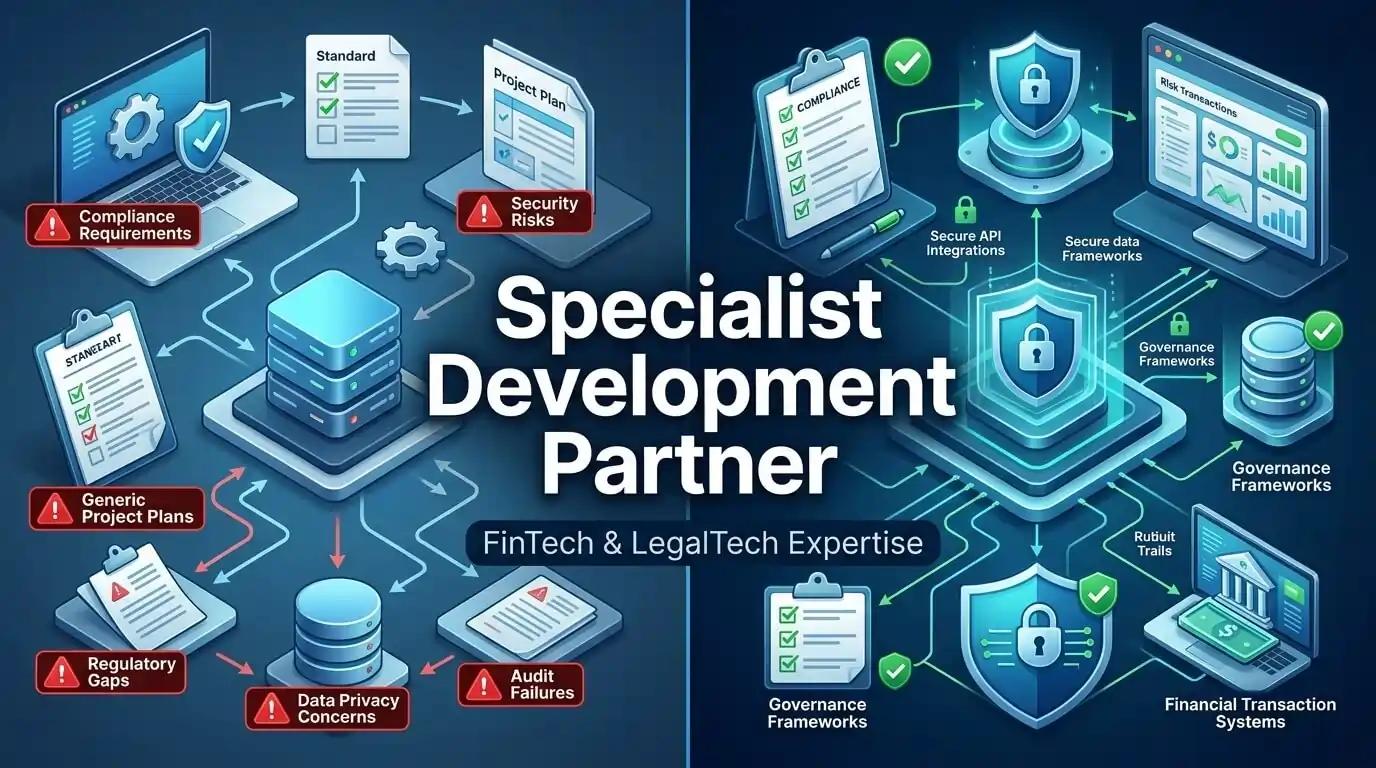
Regulatory compliance — Financial products operating in the UK, US, or EU must meet strict regulatory frameworks. PSD2, FCA guidelines, GDPR, SOC 2, PCI DSS — these aren't optional extras you bolt on at the end. They need to be baked into the architecture from day one. A generalist team will often treat compliance as a checklist item rather than a design constraint.
Data security — In both sectors, you're handling sensitive personal and financial data. That means end-to-end encryption, proper key management, audit trails, role-based access controls, and penetration testing. These are non-negotiable. A team that hasn't built secure financial systems before will underestimate what's required.
Integration complexity — FinTech products rarely operate in isolation. You're integrating with open banking APIs, payment gateways, KYC providers, credit bureaus, and core banking systems. LegalTech products connect with case management systems, court databases, and document management platforms. These integrations require deep experience — not just the ability to read an API doc.
Audit trails and accountability — Regulated industries require full traceability. Who accessed what data, when, and why. What decisions were made by the system, and on what basis. Generic development teams rarely build this infrastructure unless explicitly asked, and even then often get it wrong.
What Specialist Experience Actually Looks Like
When a development team has built in FinTech or LegalTech before, you'll notice the difference in how they ask questions, not just how they write code.
A specialist team will ask about your regulatory environment before asking about your tech stack. They'll raise compliance considerations during scoping, not after the build. They'll design your data model with audit requirements in mind from the first schema. They'll know which third-party providers are trustworthy in your specific vertical — and which ones to avoid.
At XenonDev, we've built compliance dashboards for lending platforms, legal document automation systems for process servers, and financial intelligence platforms with open banking integrations. Each of these projects came with regulatory constraints that shaped every technical decision we made — from how we structured the database to how we handled API authentication to how we designed the user permission model.
That experience doesn't live in a playbook. It lives in the judgment calls made during architecture reviews, code reviews, and client conversations.
The Compliance-First Development Approach
The right way to build in a regulated industry is to treat compliance as a first-class requirement — not a post-launch audit item.
This means:
Security by design — Every data flow is mapped and secured before a line of code is written. Sensitive fields are encrypted at rest and in transit. Access controls are designed before the UI is built.
Audit trail architecture — Every significant action in the system is logged with a timestamp, user ID, and context. This isn't optional in regulated industries — it's the minimum required for defensibility.
Third-party due diligence — Every integration partner is evaluated for their own compliance posture. Using a payment provider that isn't PCI DSS compliant, or a KYC provider that doesn't meet your regulatory requirements, creates liability that flows back to your product.
Documentation as a deliverable — Technical documentation, API documentation, and compliance documentation are treated as outputs of the build — not an afterthought.
Testing for edge cases — In regulated industries, the edge cases matter more than anywhere else. What happens when a payment fails halfway through? What happens when a document is uploaded in an unexpected format? What happens when a user tries to access data they're not authorised to see? These aren't hypotheticals — they're scenarios your team needs to have answers for before you go live.
Red Flags When Evaluating a Development Partner
Here's what to watch for when evaluating agencies for FinTech or LegalTech work:
They can't name a compliance framework relevant to your industry. If a team can't discuss PSD2, FCA guidelines, GDPR, or whichever framework governs your product without being prompted, they haven't built in your space before.
They treat security as a separate phase. Security is not a phase. It's a constraint that shapes every decision from the first line of code. Any team that says "we'll handle security at the end" is a red flag.
They have no case studies in regulated industries. Experience in adjacent sectors isn't the same as direct experience. Fintech experience doesn't automatically translate to LegalTech, and vice versa. Ask for specific examples.
They can't explain their data handling approach. Ask how they handle sensitive data in development environments. If they say they use production data for testing, walk away.
They don't ask about your regulatory environment. A specialist team will want to understand your obligations before they agree to take on your project. If nobody asks about compliance during the sales conversation, it won't be a priority during the build.
Why This Matters More at the MVP Stage
Many founders think specialist expertise is something to bring in later, once the product is validated. This is backwards.
The architectural decisions made at the MVP stage are the hardest to undo later. A compliance gap in your initial data model can mean months of rework when you're trying to scale. A security vulnerability in your early codebase can become a full rebuild when you're approaching a funding round and an investor wants a security audit.
Building right from the start is almost always cheaper than rebuilding later — especially in regulated industries where the cost of getting it wrong isn't just technical.
Conclusion
If you're building in FinTech or LegalTech, the development partner you choose will shape your product's security posture, compliance readiness, and scalability for years. The cheapest option rarely accounts for the real cost of building in a regulated environment.
Look for a team with direct experience in your sector, a compliance-first approach to architecture, and the judgment to raise the hard questions before they become expensive problems.
That's the standard we hold ourselves to at XenonDev — and it's the standard you should expect from any partner you trust with your product.
Ready to build your FinTech or LegalTech product with a team that understands regulated industries? Book a free strategy call and let's talk about your project.