Building a successful product starts with a great idea, but turning that idea into something ready to sell needs careful planning, testing, and ongoing improvement. Many startups make the mistake of spending months creating a full product without knowing if customers really want it. This can waste time, add unnecessary costs, and drive up effort without solving user problems.
This is where an MVP becomes valuable in product development. A Minimum Viable Product lets startups and businesses release a simple, working version of their product, test it with real users, gather feedback, and improve it based on real market needs. For founders, SaaS companies, and businesses entering competitive markets, MVP development offers a practical way to check ideas before spending a lot of money.
What Is MVP in Product Development?
MVP stands for Minimum Viable Product.
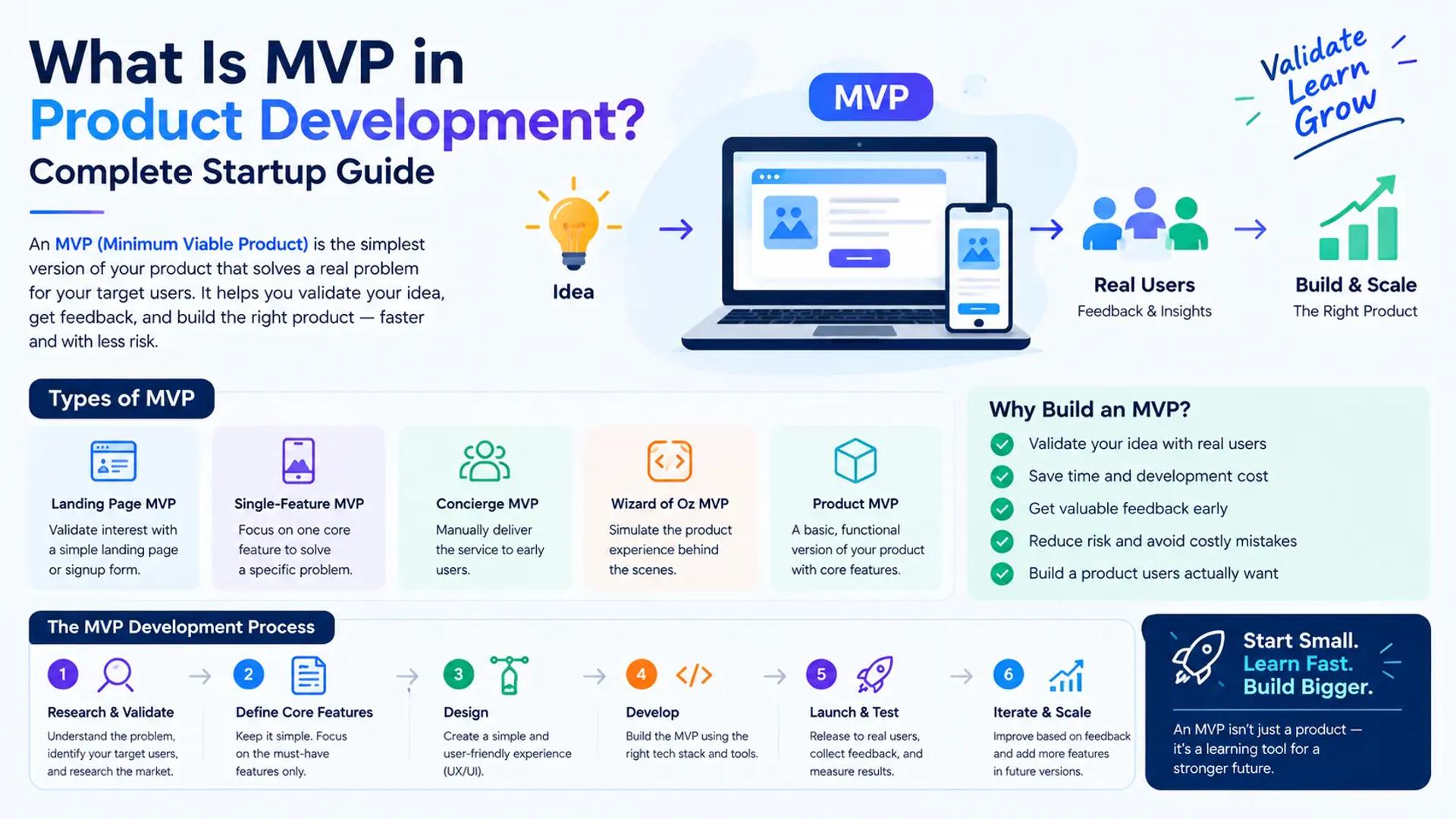
In product development, an MVP is the first version of a product that includes only the essential features required to solve a specific customer problem and provide value to early users.
The purpose of an MVP is not to build a smaller or incomplete product. Instead, it focuses on creating the simplest possible version that allows businesses to test their assumptions and understand customer behavior.
A successful MVP helps answer important questions:
- Do customers need this product?
- Does the solution solve a real problem?
- Are users willing to interact with the product?
- Which features should be improved or added next?
The main goal of MVP development is learning. Businesses use real feedback from users to make better product decisions and create solutions that match market needs.
What Does Minimum Viable Product Actually Mean?
The term Minimum Viable Product has three important parts.
Minimum
Minimum means focusing only on the features that are necessary to test the main idea.
An MVP does not include every possible feature. Instead, it removes unnecessary complexity and allows businesses to launch faster.
Viable
Viable means the product should provide enough value for users to actually use it.
A good MVP should solve a meaningful problem and offer a reason for customers to try it.
Product
The MVP should be a real working product, not just an idea, presentation, or design concept.
Users should be able to interact with it and provide feedback based on their actual
Why Is MVP Important for Startups and Businesses?
Launching a new product always involves uncertainty. Even experienced businesses cannot predict exactly how customers will react until they interact with a real solution. An MVP reduces this uncertainty by allowing companies to test their ideas before investing heavily.
Reduces Development Risk
Building a complete software product requires significant time, money, and resources. An MVP allows businesses to validate the most important assumptions first. If changes are needed, they can be made earlier when adjustments are easier and less expensive.
Helps Understand Customer Needs
Market research provides useful information, but real user behavior provides deeper insights.
Through an MVP, businesses can discover:
- Which features customers actually use
- What problems users experience
- What improvements customers want
Whether the product solves the intended problem
Saves Time and Development Costs
Traditional product development often involves building many features before launch. MVP development focuses only on essential functionality, helping businesses launch faster and avoid investing in unnecessary features.
Improves Product Market Fit
Product market fit means creating a product that customers genuinely want and find valuable. An MVP helps businesses move closer to product market fit by continuously improving the product based on real feedback.
What Is MVP in Software Development?
MVP in software development refers to creating the first usable version of a software application with core functionality that solves the primary user problem.
For software startups, an MVP may include:
- A web application
- Mobile application
- SaaS platform
- AI-powered tool
- Marketplace
- Internal business solution
The goal is not to build every advanced feature immediately. The goal is to create a reliable foundation that can be tested, improved, and expanded.
For companies developing software products, an effective MVP requires a balance between speed, quality, user experience, and future scalability.
How MVP Development Helps Reduce Product Risk
One of the biggest challenges for startups is investing resources into an idea that may not succeed.
MVP development creates a validation process where businesses can:
- Test assumptions before scaling
- Collect early customer feedback
- Identify market demand
- Improve the product direction
- Make data-driven decisions
Instead of asking, "Will this product work?" Businesses can launch an MVP and find real answers from actual users.
MVP Development Process: Step by Step
A successful MVP requires more than just coding. It involves research, strategy, design, development, testing, and continuous improvement.
Step 1: Product Discovery and Idea Validation
The first stage is understanding the business idea, target audience, and market opportunity.
During product discovery, teams analyze:
- Customer problems
- Business goals
- Competitor landscape
- Product opportunities
- Technical requirements
This stage helps define what the MVP should achieve.
Step 2: Understanding Target Users
A successful product starts with understanding the people who will use it.
Businesses need to identify:
- Who their customers are
- What challenges they face
- What solution they expect
- How they currently solve their problems
User research helps create a product that is designed around real customer needs.
Step 3: Defining Core MVP Features
One of the biggest mistakes startups make is trying to include too many features.
A strong MVP focuses on the features that deliver the main value.
The development team identifies:
- Essential features for launch
- Future improvements
- Features that can be postponed
This keeps development focused and efficient.
Step 4: UX and UI Design
A simple MVP still needs a smooth user experience.
Good UX design helps users understand the product easily and complete important actions without confusion.
The design process usually includes:
- User journeys
- Wireframes
- Interface design
- Interactive prototypes
Step 5: MVP Software Development
Once the product plan and design are ready, developers build the working MVP.
The development process may include:
- Frontend development
- Backend development
- Database setup
- API integrations
- Security implementation
- Testing
The technology choices should support both current MVP goals and future growth.
Step 6: Testing and Quality Assurance
Before launch, the MVP needs proper testing.
Quality assurance helps identify:
- Technical issues
- User experience problems
- Performance concerns
- Security weaknesses
A reliable MVP creates a better experience for early users.
Step 7: Product Launch and User Feedback
Launching the MVP is the beginning of the learning process.
After launch, businesses collect feedback through:
- User reviews
- Analytics data
- Customer interviews
- Feature requests
This information guides future improvements.
Step 8: Continuous Improvement and Scaling
Successful products continue evolving after the MVP stage.
Based on user feedback, businesses can:
- Add new features
- Improve performance
- Expand functionality
- Scale infrastructure
The MVP becomes the foundation for building a complete product.
MVP vs Prototype: What Is the Difference?
MVPs and prototypes are often confused, but they serve distinct purposes.
- A prototype is an early version made to show how a product looks or works.
- An MVP is a working product shared with real users to test main ideas and collect feedback.
A prototype helps answer:
“Can we design and build this idea?”
An MVP helps answer:
“Will customers use and value this solution in the real world?”
- A prototype usually focuses on design, ease of use, and checking the main idea.
- An MVP focuses on how people actually use it, what customers think, and making sure the product fits the market.
MVP vs Proof of Concept (POC)
A Proof of Concept (POC) and MVP also have different purposes.
A POC tests whether a technical idea is possible. An MVP tests whether customers want and use the product.
For example:
A POC may test whether a new AI technology can work.
An MVP may use that technology inside a real application that customers can use.
Both can be important steps depending on the product stage.
Features Every Successful MVP Should Include
A strong MVP usually includes:
A Clear User Problem
The product should solve a specific problem instead of trying to solve everything.
Essential Functionality
Only important features required for the core experience should be included.
Simple User Experience
Users should understand how to use the product without unnecessary complexity.
Feedback Collection
The product should allow businesses to learn from user behavior.
Scalable Foundation
The MVP should be built in a way that allows future improvements.
Examples of Successful MVP Products
Many successful companies started with simple MVP versions.
Airbnb
Airbnb started with a basic platform that allowed users to rent available spaces. The founders tested demand before expanding the platform.
Dropbox
Dropbox validated its concept through a simple demonstration before investing heavily in full development.
Uber
Uber initially launched with a limited service before expanding into a global transportation platform.
These examples show that successful products often begin with focused MVP strategies.
How Much Does MVP Development Cost?
The cost of MVP development depends on several factors, including:
- Product complexity
- Number of features
- Technology requirements
- Design needs
- Development team expertise
- Third-party integrations
A simple MVP may require fewer resources, while advanced SaaS platforms, AI products, and marketplace applications may require more development effort.
The best approach is to define clear goals and build only what is necessary to validate the product idea.
How Long Does It Take to Build an MVP?
The MVP development timeline depends on the product type and complexity.
A simple MVP may take a few weeks, while more complex applications may require several months.
Factors that influence development time include:
- Feature requirements
- Platform choice
- Design complexity
- Testing requirements
- Integration needs
A proper discovery phase helps create a realistic timeline before development begins.
Common MVP Development Mistakes Startups Should Avoid
Building Too Many Features
An MVP should focus on validation, not creating the complete final product.
Too many features increase cost and delay launch.
Ignoring Customer Feedback
The purpose of an MVP is learning.
Ignoring user feedback can prevent businesses from improving the product.
Treating MVP as a Low-Quality Product
An MVP should have limited scope, but it should still provide a reliable user experience.
Building Without a Clear Goal
Every MVP should have a clear purpose and measurable outcome.
Why Choose XenonDev for MVP Development?
Building an MVP requires more than software development skills. Businesses need a partner who understands product strategy, user needs, technology, and future growth.
XenonDev helps startups and businesses transform ideas into scalable digital products through custom software development, web applications, mobile apps, AI solutions, UI/UX design, and modern technology solutions.
The team focuses on helping businesses validate ideas, build functional products, and create solutions that can grow with changing market needs. XenonDev also highlights startup support, MVP creation, product validation, and scalable development approaches as part of its product-focused work.
With the right MVP strategy, businesses can reduce risk, launch faster, and make better decisions based on real customer feedback.
Final Thoughts
MVP in product development is not about making a smaller version of a finished product. It is about creating the right product at the right time. For startups and businesses, an MVP offers a simple way to test ideas, learn about customers, and improve solutions before spending a lot. A well-planned MVP can be the basis of a successful digital product by focusing on one main goal: solving real customer problems.
Frequently Asked Questions About MVP Development
What does MVP mean in product development?
MVP means Minimum Viable Product. It is the first functional version of a product created to test an idea with real users and collect feedback.
Why should startups build an MVP?
Startups build MVPs to validate ideas, reduce development risks, understand customers, and avoid unnecessary investment.
Is an MVP the final product?
No. An MVP is the first version of a product that can be improved based on customer feedback and market response.
How long does MVP development take?
The timeline depends on product complexity, features, technology requirements, and development approach.
How much does MVP development cost?
MVP development costs vary depending on design, features, platform, integrations, and technical requirements.
Can an MVP become a complete product?
Yes. Many successful products begin as MVPs and grow into complete platforms through continuous improvement.